
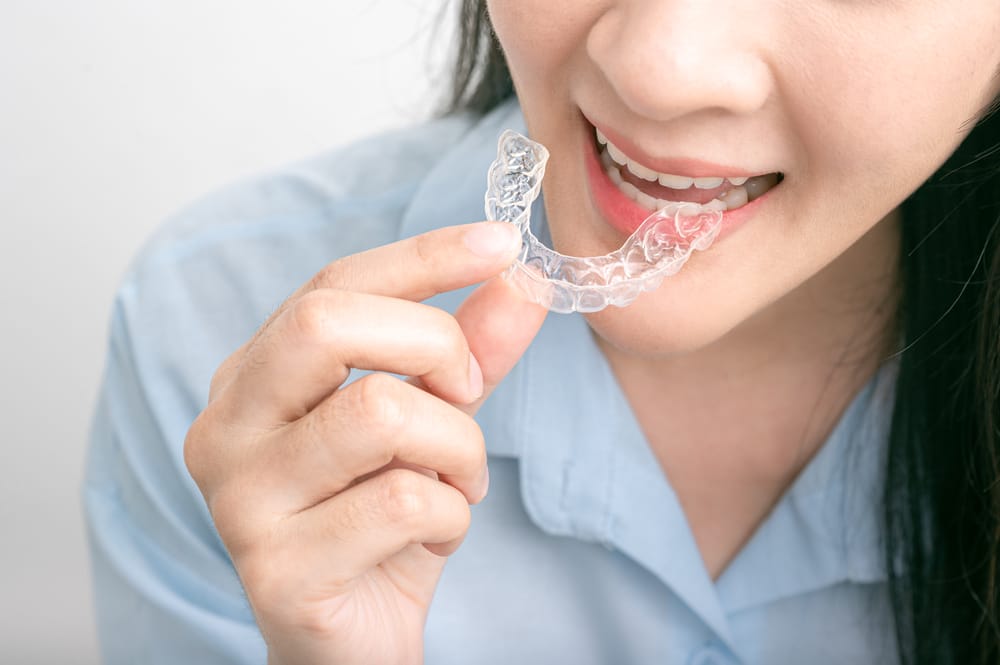
Invisalign for adults often works when teenage braces did not hold. Understanding why starts with what happens after treatment ends.
Many adults assume their original orthodontic care simply failed. Documented reasons point elsewhere.
Three factors explain the shift, and each one traces back to the retention phase rather than the braces themselves. This article breaks down what causes relapse and why the lower arch is the most common trouble spot. It also covers how a custom treatment plan with removable aligners addresses both.
Key Takeaways
- Retention failure, not braces failure, causes most adult relapse.
- Crowded teeth along the lower arch relapse most often, and clear aligners suit that pattern well.
- Removable aligners simplify oral hygiene by eliminating fixed appliance hardware.
- Adult retreatment typically means a shorter, more custom treatment timeline than first-time care.
- A professional evaluation can confirm whether your case fits this treatment path.
Why Orthodontic Treatment After Teen Braces Shifts Back: The Retention Problem
Orthodontic treatment moves teeth into new positions, but it does not lock them there permanently. Retainers do that job, and when retainer wear stops, teeth drift back toward where they started.
A retrospective cohort study on clear aligner compliance examined adult retreatment patients. Most patients no longer had retainers by the time of their clinical appointment.
The original braces were not inadequate. Patients simply stopped wearing their retainers.
The same study found that patients with prior metal braces showed lower compliance during clear aligner therapy. This held true compared with patients who had no orthodontic history.
That pattern points to the same root issue across both groups. Retention habits, not the quality of the original orthodontic appliances, determine whether results last.
You may have worn metal brackets as a teen and watched your teeth shift since. Your first round of orthodontic care likely still did its job. The retention phase, not the treatment itself, is where things broke down.
Do permanent teeth keep moving on their own?
Retention non-compliance explains most adult relapse, but aging plays a role too. Permanent teeth continue to shift slightly throughout adulthood, regardless of prior orthodontic care.
Several factors contribute to this natural movement:
- Inter-canine width narrows gradually with age, independent of retainer use
- Bone density changes can loosen the support around tooth roots over time
- Natural forward drift adds pressure to the front teeth over decades
- Untreated bite irregularities or TMJ disorders from adolescence can resurface without a retention plan
Retainers hold against that pressure. Without consistent wear, the drift wins.
Adult retreatment is not just about correcting what shifted. It is also about building a retention plan for permanent teeth that keep moving after treatment ends.
How Invisalign Treatment Addresses Adult Relapse Where Braces Left Off
Not every case is a good fit for clear aligners, but adult retreatment after braces often is. The reason comes down to where relapse happens most. A custom treatment plan can target that spot precisely for adults returning to orthodontic care.
A clear aligner literature review confirms that clear aligners can be used in mild to moderate crowding cases. Results are comparable to braces for these cases.
The same review names the mandibular arch as the least stable area after orthodontic treatment. That is exactly where most adults see crowded teeth return.
Open Bite and Crowded Teeth: Common Patterns in Adult Relapse
Crowded teeth along the lower front arch account for most adult relapse cases. A mild open bite can also develop gradually if retention lapses for several years. This pattern shows up less often than crowding.
Signs worth reevaluating with a dental professional include:
- Crowded teeth returning along the lower front arch
- A subtle open bite change noticed when biting down
- Minor rotation on one or two front teeth
- Shifting that becomes visible in recent photos compared to older ones
Dental issues like these are usually manageable within a shorter treatment timeline. The original orthodontic care already handled the larger movements.
How a Custom Treatment Plan Comes Together
Adult retreatment starts with treatment planning that maps out exactly how much movement the case needs. Because the original braces already did the heavy lifting, this treatment process is usually more contained.
A typical treatment process includes:
- An initial evaluation and treatment planning session
- Custom aligner fabrication based on the specific crowding pattern
- Progress tracking through each aligner set
- Adjustment appointments scheduled as needed to confirm results
Treatment duration depends on how much correction the case needs. Mild-to-moderate cases typically require fewer aligners than a full first-time treatment.
Daily wear time is the main compliance factor in clear aligner therapy. Adult orthodontic patients tend to follow through more consistently than first-time patients.
Patients pick up new aligner sets on a schedule, and in-office visits confirm treatment is progressing. Some patients notice a short speech adjustment in the first few days of a new aligner set. A lasting speech impediment is not a typical outcome of clear aligner therapy.
Fewer appointments make it easier for adults managing full schedules to stay on track from start to finish. Patient results are generally strong when the case fits the treatment.
Clear Aligners, Oral Health, and Why Removability Changes Everything for Adults
Oral health care at 35 looks different than it did at 15. Adult patients are more likely to have gum problems, prior dental work, and a longer history of plaque buildup. Clear aligners handle that reality differently than fixed appliances.
Fixed Appliances vs Removable Aligners: The Hygiene Difference
Fixed appliances make oral hygiene harder because food and plaque collect around brackets and wires. Removable aligners avoid that problem by coming out completely for eating and brushing.
Removability changes the oral hygiene routine in a few clear ways:
- You clean your teeth exactly as you normally would, with nothing to work around
- There is no bacteria buildup in tight spaces around wires
- The gum line stays fully accessible throughout smile treatment
- Dental hygiene routines do not need to change once aligners go in
One patient survey found that satisfaction rates were 92% for clear aligners compared with 76% for braces. Comfort and appearance scored particularly high.
The discreet method behind clear aligners matters most to adults in professional or social settings. It is often the deciding factor in starting smile treatment at all.
Food restrictions look different with removable aligners too. Patients in metal braces avoid certain food and drinks, including red wine, to protect brackets and wires. With clear aligners, you remove them before eating or drinking anything besides water.
Gum disease risk is a real concern for adult orthodontic patients regardless of appliance type. Fixed appliances that trap food can make existing gum problems worse. Keeping the gum line accessible reduces that risk throughout treatment.
A five-year cohort study compared traditional braces with Invisalign. Patient satisfaction scores were consistently higher in the Invisalign group at every follow-up visit. Clinical outcomes stayed comparable between both groups.
A separate systematic review found that Invisalign patients experienced (“shorter treatment times and higher patient satisfaction” [https://pmc.ncbi.nlm.nih.gov/articles/PMC11805322/]). This held true compared to those treated with fixed appliances.
The clinical results are similar. The day-to-day experience, and the orthodontic journey overall, is not.
See If Invisalign for Adults Fits Your Smile
Invisalign for adults works because it targets the exact reason relapse happens. Patients stopped wearing their retainers; the braces did not fail them the first time around.
Crowded teeth along the lower front arch relapse most often. Current research also best supports clear aligner treatment in that same area.
Removability makes daily oral health care easier for adults in ways fixed appliances cannot match. A custom treatment plan usually means a shorter timeline than starting from scratch.
Dr. Lindsay Bancroft at Carmel Valley Dental works with adults facing exactly this kind of relapse every day, and a short visit is often all it takes to map out next steps. Book with us today!
FAQs
Does insurance cover Invisalign for adults?
Coverage varies by plan. Some dental insurance policies apply an orthodontic benefit to Invisalign the same way they would to braces. Others exclude adult orthodontic treatment or cap the benefit at a set amount. Carmel Valley Dental can help verify your specific coverage.
How much is Invisalign for adults?
Cost depends on how much movement your case needs. A focused adult retreatment case is typically less expensive than starting from scratch. Financing options, including CareCredit, can help spread out the cost. A consultation gives you a personalized estimate.
Does Invisalign work for adults?
Yes. Invisalign is well-documented for mild-to-moderate crowding, which is the most common presentation in adult retreatment cases. Clinical literature confirms results comparable to traditional braces for appropriate case types. Adults returning after prior braces often have focused cases that align well with what clear aligner therapy does best.
How long does Invisalign take for adults?
It depends on how much movement the case needs. Adult retreatment cases involving mild relapse typically require fewer aligners and a shorter treatment timeline than first-time orthodontic treatment. A dental professional can give you a specific estimate after evaluating the degree of crowding. From there, they’ll map out a treatment plan.
Can Invisalign for adults make teeth loose?
Invisalign doesn’t cause permanent loosening. All orthodontic treatment involves some temporary tooth mobility as teeth move through bone, and that’s expected. Patients with existing gum disease or bone loss should share those dental concerns before starting. Active periodontal conditions can affect how teeth respond to any orthodontic appliance.
